
What to Expect When Hiring an AV Company for Your Corporate Event
If you've never hired an outside AV company for a corporate event, the process can feel opaque. What happens after you make that first call? How far in advance should you start? What should a good AV partner actually deliver? Whether you're a seasoned event planner looking to switch providers or booking outside AV for the first time, here's a clear walkthrough of the process from start to finish — and what separates a reliable partner from a vendor who's just filling an order.
Step 1: Initial Consultation
The process begins with a conversation. A good AV company will want to understand your event before quoting a single dollar. Expect questions about your event type (conference, meeting, awards gala), attendee count, venue, content format (keynotes, panels, breakouts, hybrid streaming), and goals. What impression do you want to leave? What's worked well at past events? What hasn't?
This isn't a sales pitch — it's discovery. The information gathered here shapes every recommendation that follows. Be honest about your budget range during this conversation. A transparent AV partner won't upsell you on equipment you don't need, but they can only tailor a solution if they know your financial boundaries. Explore our full range of AV services to get a sense of what's available before your first call.
Step 2: Site Visit
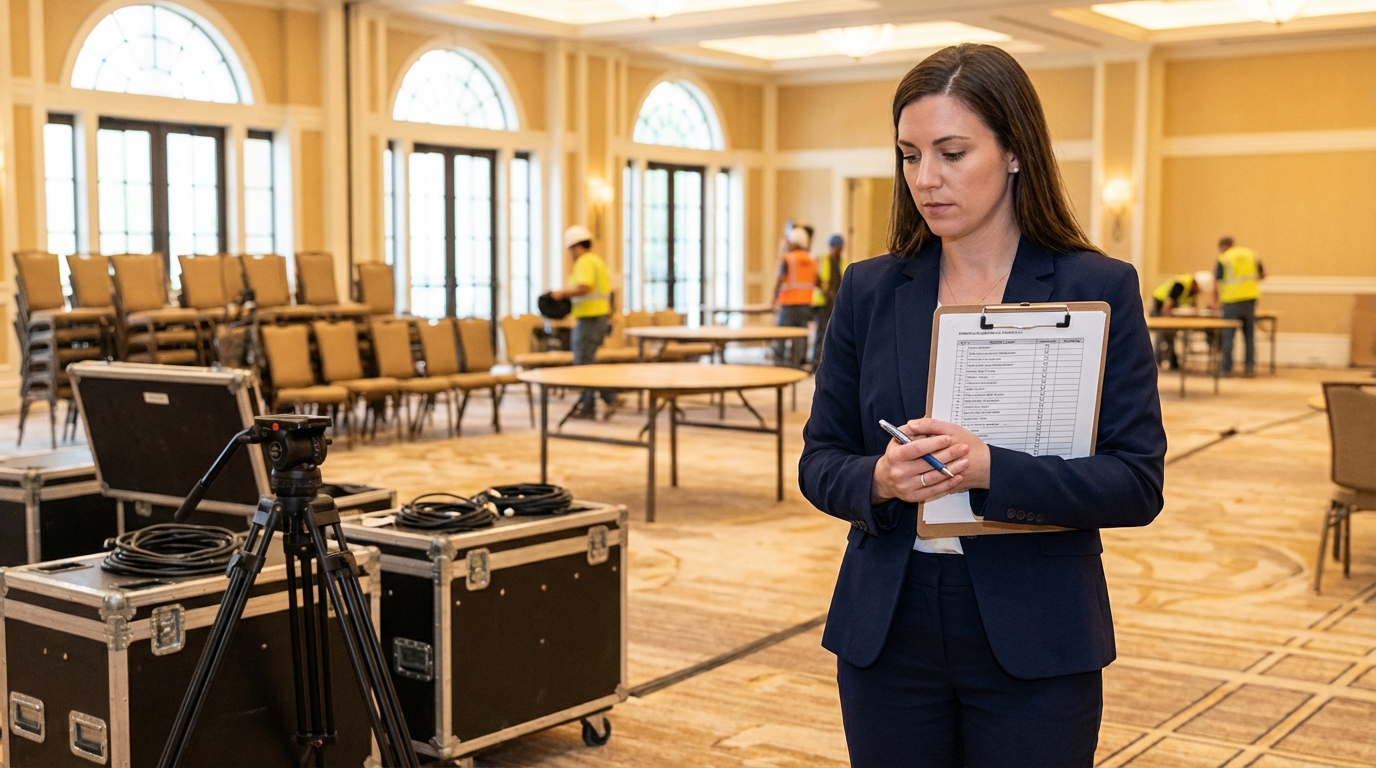
For any event beyond a basic meeting, a reputable AV company will want to visit the venue in person. During the site visit, the technical team assesses the room dimensions, ceiling height, power availability, rigging points, ambient light conditions, acoustics, internet infrastructure, and load-in logistics. They'll identify potential problems — a column that blocks sightlines, a low ceiling that limits screen size, electrical circuits that can't handle the equipment load — and start planning solutions.
If a site visit isn't possible (for example, if the venue is in another city), your AV partner should request detailed floor plans, ceiling height measurements, photos, and direct contact with the venue's technical staff.
Step 3: Proposal and Quote
After the consultation and site visit, you'll receive a detailed proposal. This should be far more than a list of equipment and prices. A quality proposal includes an equipment list broken down by category (audio, video, lighting, staging, streaming), labor costs for technicians and engineers, setup and strike timelines, a production schedule, and any venue-specific requirements or fees.
Look for transparency. Every line item should be clear and understandable. There should be no hidden fees, ambiguous "miscellaneous" charges, or surprise costs that appear later. If something in the quote doesn't make sense to you, ask about it. A trustworthy AV partner welcomes those questions because they've got nothing to hide. Learn more about our approach to transparent pricing.
Step 4: Pre-Production Planning
Once you approve the proposal, the real planning begins. Your AV team will work with you to finalize the production schedule, create detailed equipment plots and signal flow diagrams, coordinate with the venue on logistics, and begin preparing content templates for presentations. This phase typically includes regular check-in calls or emails to track progress, gather presenter information, and address any changes to the event program.
Pre-production is where a great AV company distinguishes itself from an adequate one. The level of preparation during this phase directly determines how smoothly the event runs. Companies that skip or rush pre-production are setting up for problems on show day.
Step 5: Load-In and Setup
On load-in day, the AV crew arrives at the venue to unload, position, and connect all equipment. For a mid-size corporate event, this typically takes 4 to 8 hours depending on complexity. The team will build the stage, hang or stack speakers, set up screens or LED walls, run cable, install lighting, configure the audio mix, test all video sources, and establish any streaming or recording infrastructure.
During setup, the production manager should keep you informed of progress and flag any issues immediately. A professional crew will leave the space clean, organized, and cable-managed — no tripping hazards, no visible cable runs through audience areas.
Step 6: Rehearsal
Never skip the rehearsal. This is when presenters walk the stage, test their microphones, practice with the clicker, review their slides on the actual screen, and get comfortable with the environment. For the AV team, rehearsal is the final opportunity to fine-tune audio levels, lighting cues, video switching, and any timed elements.
Plan for at least a 1 to 2 hour rehearsal for general sessions. Even a 15-minute run-through for breakout presenters dramatically reduces technical issues during the live event.
Step 7: Show Day
On the day of the event, your AV team should be virtually invisible to your audience. Technicians are at their stations managing audio, switching video, controlling lighting, and monitoring any live streams. A technical director or production manager serves as your single point of contact, handling any last-minute changes or issues so you can focus on your attendees and speakers.
This is where all the planning pays off. A well-prepared AV team handles the unexpected — a presenter who changes their laptop at the last minute, a session that runs long, a microphone that needs swapping — without your audience ever noticing.
Step 8: Teardown and Follow-Up
After the event concludes, the AV crew handles teardown and load-out, returning the venue to its original condition. A good AV company will also follow up after the event to deliver any recordings or edited content, gather your feedback, and discuss what could be improved for future events. This post-event debrief is invaluable for building a long-term partnership.
What to Look for in an AV Partner
Beyond the process, here are the qualities that define a great AV partner:
- Responsiveness — they answer calls and emails promptly, not days later
- Transparency — clear pricing with no hidden costs
- References — they can point to similar events they've successfully produced
- Flexibility — they adapt when your plans change, because plans always change
- Ownership — they treat your event like their reputation depends on it, because it does
Ready to start the conversation? Reach out to our team for a free consultation. We'll walk you through exactly what your event needs — no pressure, no fluff.
Astro Audio Visual Team
Expert AV production for corporate events in San Antonio, Austin & Houston.